
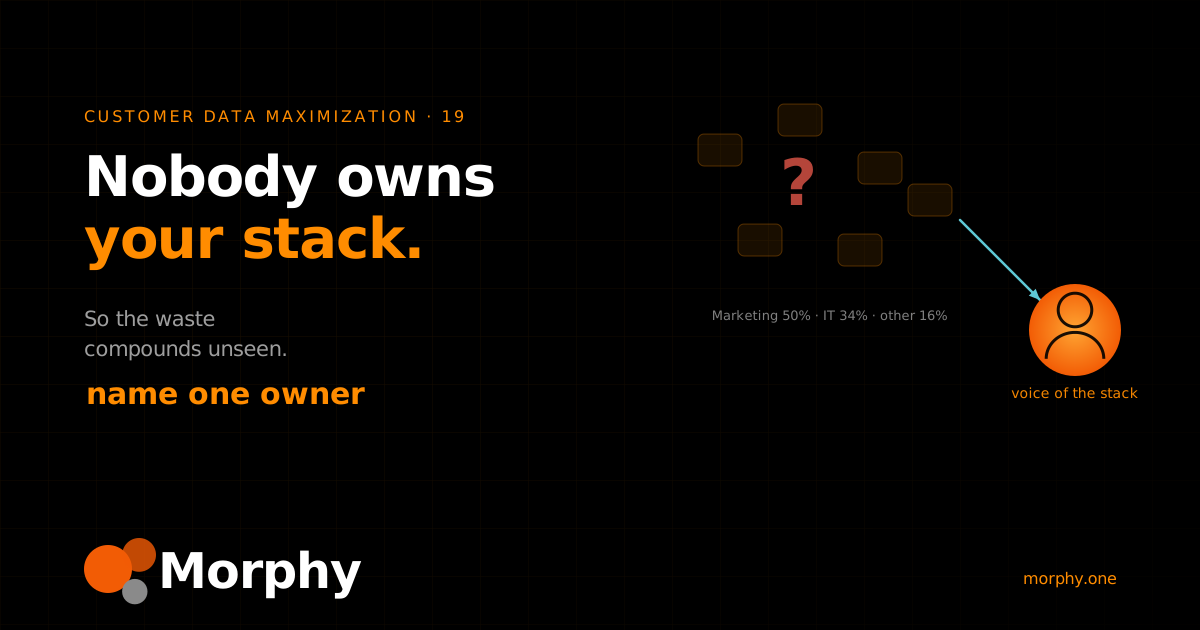
Nobody owns your martech stack because marketing pays only half the bill. IT and other teams cover the rest, so ownership is split and accountability disappears. No single person knows every tool, every overlap, or every contract. You fix it by naming one owner, a voice of the stack, accountable for the full inventory, utilisation, and roadmap.
Ask who owns your martech stack and watch the answer arrive as a list. Marketing owns the campaign tools. IT owns the integrations. RevOps owns the CRM. Finance owns the contracts. Everyone owns a slice, so nobody owns the whole.
Why nobody ends up owning the stack
Ownership follows the money, and the money is split three ways. Marketing pays only 50% of the enterprise martech bill. IT covers 34%. Other departments pick up the remaining 16% (Gartner via Marketing Week).
Three payers, no single owner. That is the whole mechanism. Each group funds its own corner and watches its own corner. None of them sees the full picture, because seeing the full picture is not anyone’s job.
So the overlaps hide in the gaps between budgets. Marketing buys a tool that does what an IT-funded platform already does. Nobody notices, because the two tools sit in two budgets that no one reads side by side. A contract renews on autopilot because the person who signed it left and no one inherited the file.
Waste does not announce itself here. It compounds quietly, one unexamined licence at a time, precisely because no single person is accountable for the total.
The evidence
The number that explains everything is the split. Marketing pays 50% of the martech bill, IT 34%, other teams 16% (Gartner via Marketing Week). Fewer than half the dollars sit with the team most people assume owns martech.
That split is why the awareness is so low. There is no single dashboard where the whole cost lands, so there is no single person who feels the whole cost. The gap hides inside the org chart, not inside a tool.
I have run the version of this that works. At Cisco we built the global inbound demand-generation engine to a 628 million dollar pipeline, and it worked because one team owned the engine end to end. Not the leads, not the integrations, the engine. Clear ownership is what turned a pile of tools into a result.
Is this you?
Five checks. Answer each yes or no.
- Can you name, right now, the one person accountable for your entire martech stack?
- Do you have a single live inventory of every tool, its cost, and its renewal date?
- Do two teams pay for tools that do substantially the same job?
- When a martech contract renews, does anyone decide to keep it, or does it just roll?
- Are buy and cut decisions made by whoever argues hardest in the meeting?
Three or more uncomfortable answers means your stack is unowned. The bill is still arriving.
What the ownership gap costs
The cost is not one big number. It is many small ones that never get added up.
It shows up as duplicate spend. You pay twice for one capability because two budgets each bought it. It shows up as dead licences. Seats sit unused because the team that bought them moved on and nobody reclaimed them. It shows up as bad decisions. With no owner holding the full inventory, the loudest voice wins the roadmap, not the best case.
And it shows up as capped value from everything else you are trying to do. If you cannot see the whole stack, you cannot see that you already own the tool for the job, so you buy another. That is how martech sprawl turns into the buy-a-tool reflex, and both trace back to the same missing role.
None of it appears on a line labelled “no owner”. All of it is real money leaving the building.
Name one owner
The fix is almost embarrassingly cheap. It costs an org-chart line, not a budget.
Name a voice of the stack. One person, accountable for the whole thing. Not a committee, not a shared responsibility that dissolves into no responsibility. A single named owner who can answer for every tool, every overlap, and every contract.
Give them the full inventory, utilisation, and roadmap. Their job is to hold one live list of what you own, track how much of each tool is actually used, and own the decision on what stays, goes, or merges. When someone wants to buy, they ask the owner. When a contract nears renewal, the owner decides, rather than letting it roll.
Write utilisation into their objectives. This is the part that makes it stick. Put martech utilisation into that person’s performance objectives, so getting value from the stack you already own is how they are measured, not a favour they do in spare time.
This is a quick win precisely because the hard part is a decision, not a purchase. You are not buying a tool to fix the problem that too many tools created. You are naming who is responsible for the ones you have.
Get the full martech stack ownership playbook.
Ownership before optimisation
You cannot optimise a stack that nobody owns. Every efficiency project, every consolidation, every “let’s finally use what we bought” push needs a person who can see the whole board and is measured on the result.
The systems talking to each other is the layer beneath this. Even with an owner named, the tools still have to connect, which is integration debt. But the owner is what turns that work from a stalled ticket into a funded decision. Name the person first. The rest gets easier once someone is accountable for the total.
Go deeper on customer data maximization
Three ways forward. Pick the one that fits where you are.
- Get the playbook. Practical notes on turning the customer data you already own into revenue, straight to your inbox. Join the newsletter at the foot of this page.
- Take the assessment. Score your customer data maximization in four minutes and see your top revenue blockers. Start the assessment →
- Book a meeting. Bring your data problem. Leave with a prioritised fix, not a platform pitch. Book a call →
Post 19 of 25 in the Customer Data Maximization series. Previous: Why don’t your systems talk, and how do you pay down integration debt?. Next: Stop buying a tool for every gap.
Frequently asked questions
Who should own the martech stack?
One named person, not a committee. Give them accountability for the full inventory, how much each tool is used, and the roadmap for what stays, goes, or gets consolidated. Marketing pays only 50% of the enterprise martech bill (Gartner via Marketing Week), so ownership has to span every team that funds it.
Why does split funding cause a martech ownership gap?
Marketing covers 50% of the bill, IT 34%, and other departments 16% (Gartner via Marketing Week). When three groups pay, no single group owns the whole. Nobody sees every tool, every overlap, or every contract, so duplicate licences and unused seats build up unnoticed.
What does a martech stack owner actually do?
They keep one live inventory of every tool and contract, track utilisation against each licence, and own the roadmap for consolidation. They are the single voice of the stack, so any buy, renew, or cut decision goes through one accountable person instead of whoever argues loudest.
How much does it cost to fix martech ownership?
Almost nothing. Naming an owner is an org-chart line, not a new budget or platform. That is why it is a quick win. The saving comes from spotting the overlapping tools and dormant licences that split ownership let build up unseen.
How do you make martech ownership stick?
Put stack utilisation into the owner's performance objectives. If getting value from the tools you already own is written into how someone is measured, it stops being everyone's job in name and nobody's job in practice. Measured ownership is the difference between a title and a result.