
Customer data decay costs you twice: first through reach (fewer valid contacts), then through relevance (weaker response from the contacts you still have). A 5% increase in customer retention raises profit by 25–95% (Bain & Company via Harvard Business Review). That number has not been debunked in 20 years because the maths is straightforward. Retained customers buy more, cost less to serve, and refer others.
Yet most data teams treat retention as a reporting metric, not an operational one. They build dashboards. They present quarterly. They never wire the signal to an action fast enough to matter.
Post 1 in this series established the problem: your customer data is decaying right now. Contact details go stale. Preferences shift. Engagement fades. The data half-life formula shows exactly how fast. This post shows you what to do about it. The fix is operational. No new tools. No 12-week project. Just a tighter loop between signal and action.
Work backwards from the action
Most retention work starts at the data. It should start at the outcome.
Pick one action you want to cause. Not five. One. For this playbook, the action is: recover customers whose spending is slowing before they lapse.
Now define the signal. What does “spending is slowing” look like in your data? Three consecutive months of declining transaction value compared to the prior six-month average. Or two missed purchase cycles for a subscription-adjacent product. Pick the definition. Write it down.
You now have a group. Not a segment from a planning workshop. A group defined by the action you intend to take. This is the difference between analytics and operations. It is also the foundation of customer data maximization — activating records at peak value instead of watching them decay.
How to run a reachability audit
You have your group. Now ask the uncomfortable question: how many of these customers can you actually reach?
Check each channel. Email: do you have a valid, opted-in address? Is it opening? SMS: do you have a mobile number, and has it received a message in the last 90 days? App push: is the app installed with notifications enabled? Direct mail: is the postal address current?
Map it. The output is a simple grid: customer group on one axis, channel availability on the other.
What you will likely find: 40–60% of your highest-value at-risk customers are reachable on exactly one channel. That is fragility. If that channel stops working (email lands in spam, the app gets deleted, the number changes), you have no path to the customer.
Single-channel reachability is not a data quality issue. It is a revenue risk. The Tesco Clubcard programme succeeded in part because it held multiple touchpoints per customer — statement mail, store receipt, and digital — so no single-channel failure could sever the relationship.
Cross-collection as insurance against data decay
The time to collect a second channel is before you need it. Not when the first one fails.
While a customer is active and engaged on email, ask for their mobile number. While they are browsing the app, prompt for email opt-in. While they are in-store, capture the app download.
This is cross-collection. It is cheap. It takes one touchpoint, one incentive, one ask. The cost is near zero when done during a natural interaction.
The cost of not doing it: an unreachable customer whose lifetime value you wrote off because you had no backup path.
Build cross-collection into your standard engagement flow. Every active customer should be reachable on at least two channels within 90 days of first purchase. Set that as a KPI. Track it weekly.
The “still alive” signal
Customer data decay is silent. Customers do not announce they are leaving. They just stop responding.
Build a monthly “still alive” check. Send a lightweight email to your entire active base. Not a campaign. Not a promotion. A simple, value-carrying touchpoint: a tip, a reminder, a small update. Something worth opening.
The purpose is not conversion. It is detection. Opens confirm the address works and the customer is reachable. Silence is a signal. Three consecutive months of no open on a previously active address means the record is decaying. Flag it. Move it to a re-engagement queue or cross-collect on another channel while you still can.
This costs nothing. One email a month. The insight it generates is worth more than most quarterly analytics reports.
Pre-build automated retention actions
Here is where most companies fail. Not in the analysis. In the response.
The signal fires. A customer’s spend has declined for three months. The data team sees it. Then what? A report goes to a manager. The manager asks for context. Someone pulls a list. A meeting is scheduled to discuss what to do. By the time an action happens, the customer has been gone for six weeks.
Kill the committee. Replace it with a pre-built response.
Write it as a rule: “When spend declines for three consecutive months relative to the six-month average, send the retention offer on the customer’s primary reachable channel. One owner. Fires daily. No approval needed.”
One person owns the trigger. They check it every morning. Or better: it runs automatically and they check the exceptions. The action is pre-approved. The creative is pre-built. The offer is pre-defined.
You are not asking permission to retain a customer. You are executing a standing order. The global card issuer case used exactly this pattern — predictive cancellation signals wired to a pre-approved retention response — and saved 35% of at-risk accounts, protecting $5m+ in fees every month.
Wire the insight pipe to the action pipe
Most companies have two disconnected systems. One produces insights. The other takes actions. A human sits between them, translating and prioritising.
That human is your bottleneck.
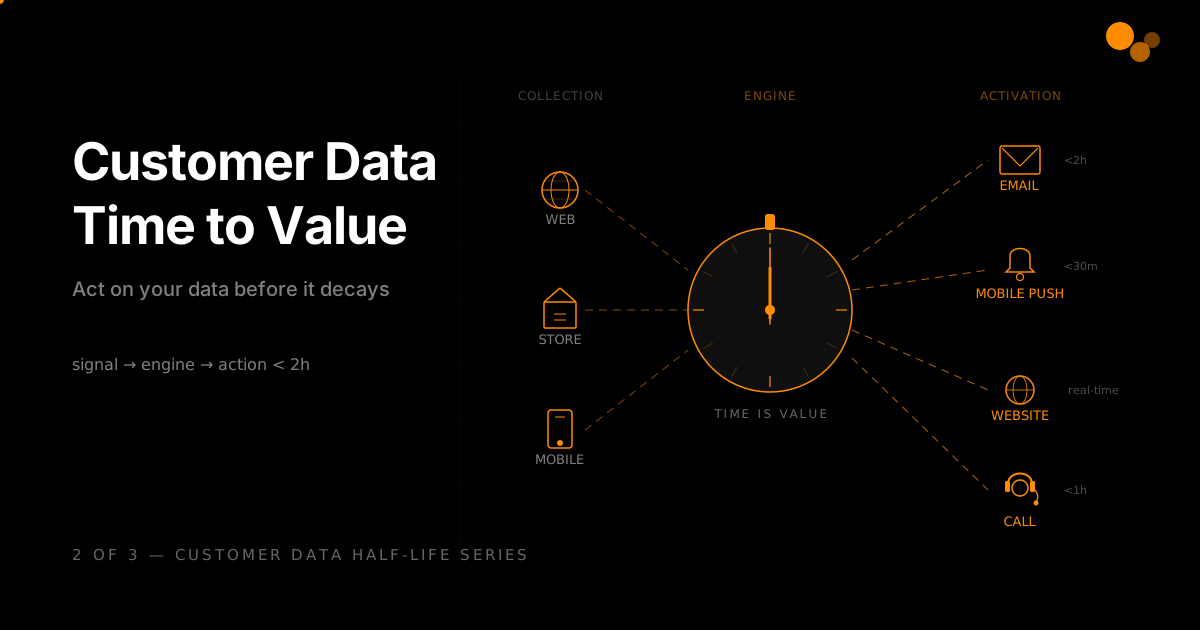
Wire them together. The analytics platform identifies the signal. The signal triggers the action. The action fires on the channel. The outcome feeds back to the analytics platform for measurement.
This is not a technology problem. CRM tools, CDPs, and marketing automation platforms can all do this today. The gap is operational. Nobody has written the rules, assigned the owner, or approved the standing logic.
Sit down for one afternoon. Define three signals. Define three responses. Define three owners. Wire them. You will have automated more retention activity than most companies produce in a quarter.
Act on the biggest signals, not every signal
A common failure mode: the team identifies 47 signals and tries to act on all of them. Nothing ships. Complexity wins.
Prioritise by two factors: customer value and decay speed.
High-value customers decaying fast go first. That is your retention revenue at immediate risk. A top-20% customer whose spend dropped 40% in two months is worth more intervention than a bottom-50% customer who missed one purchase cycle.
Draw a simple 2×2. Value on one axis. Decay speed on the other. Work the top-right quadrant first. Ignore the bottom-left entirely. You do not have infinite capacity. Spend it where the return is highest.
Three actions running daily on your highest-value, fastest-decaying segment will outperform 20 actions planned but never launched.
The customer data decay playbook, one page
- Pick one outcome. One.
- Define the signal that predicts it.
- Audit reachability for the group. How many channels per customer?
- Cross-collect a second channel while they are still active.
- Run a monthly “still alive” email to detect decay early.
- Pre-build the response. One owner. Fires daily. No meeting.
- Wire signal to action. Remove the human bottleneck.
- Prioritise by value × decay speed. Ignore the rest.
None of this requires new data. None of it requires a new platform. It requires operational discipline and one person who owns the trigger.
The companies that retain customers are not the ones with the best data. They are the ones that act on it fastest. That is the core of customer data maximization — and it starts with understanding your data half-life.
Most companies can only reach their best customers on one channel. If that channel fails, you have no path back. A reachability audit maps your real coverage and identifies the gaps before they cost you revenue. Book a session and we will run the audit with you.
This is Post 2 of 3 in the Data Half-Life series. Next: The Governance Trap — how your own rules are killing your data faster than time is.
Frequently asked questions
How much profit impact can a 5% retention increase drive?
Research from Bain & Company and Frederick Reichheld (via Harvard Business Review) shows a 5% increase in customer retention can raise profit by 25–95%, depending on the industry. Retained customers buy more frequently, cost less to serve, and refer others.
What is a reachability audit?
A reachability audit maps how many channels you can actually contact each customer segment on today. It reveals single-channel fragility — customers you can only reach by one method — and identifies gaps to fill before that channel decays or the customer disengages.
What is cross-collection in customer data?
Cross-collection means capturing a backup contact channel (like a mobile number or app push token) while customers are still engaged on their primary channel. It acts as insurance against single-channel decay. If email stops working, you still have a path to the customer.
How quickly does customer data decay?
Customer data decay is faster than most teams realise. Email open rates drop 2–3% per quarter for dormant lists. Phone numbers churn at 10–15% annually. Without active maintenance and regular engagement signals, a customer record can become unreachable within 12–18 months.
Working on a similar problem?
Book a discovery call