
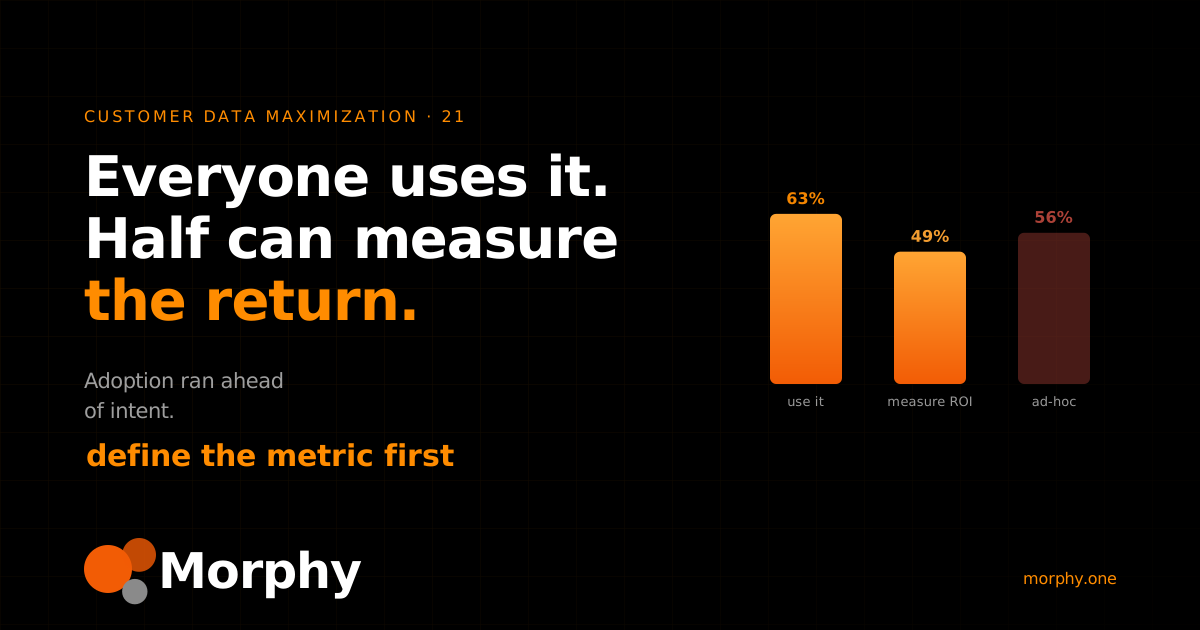
You cannot measure generative AI ROI because you adopted the tools before you defined the outcome. Most teams bought in to keep pace, then never set a metric. The fix is to pick each use case by the business result it should move, and name that metric before you switch anything on.
A marketing lead tells me their team uses AI every day. I ask what it is worth. The answer is a pause, then a shrug. The tools are in the workflow. The return is a feeling, not a number.
Why generative AI ROI goes unmeasured
Adoption ran ahead of intent. When generative AI arrived, the pressure was to keep pace, not to build a case. Teams switched the tools on because everyone else was switching them on. The outcome to measure against was never defined, so there is nothing to measure now.
This is the opposite of how good projects start. Normally you name the result, then find the tool. Here the tool came first and the result was assumed. That gap is the whole problem.
It compounds because the tools are used in isolation. One person drafts emails with AI. Another summarises calls. Nobody connects those uses to a shared metric, so each stays a private productivity trick that no report ever counts.
The reflex is to ask which AI tool to buy next. Wrong question. The teams that cannot measure what they already run do not need more tools. They need a metric attached to the ones they have.
The evidence
The numbers show a wide gap between use and measurement. 63% of marketers use generative AI, but only 49% measure its return, and 56% use it in isolated, ad-hoc ways (Jasper, 2025). More than half are getting value they cannot see, and a quarter are not even trying to see it.
It gets worse the smaller the team. Among the smallest teams, ROI measurement falls to 38% (Chief Marketer, 2025). The teams with the least room for wasted spend are the least likely to know whether the spend worked.
The use pattern explains why. Content generation, the simplest use case, sits at 57% of adopters, while predictive analysis sits at 23% (Jasper, 2025). The easy use cases dominate and the high-value ones stall. Teams reach for what is quick, not for what pays.
Is this you?
Five quick checks. Answer each yes or no.
- Can you name the single metric your biggest AI use case is meant to move?
- Did you set a baseline before you rolled the tool out, so you have something to compare against?
- Is your AI use mostly content generation, with the higher-value predictive work still on the wishlist?
- Are people using AI in private workflows that no shared report ever counts?
- If finance asked for the return on your AI spend tomorrow, could you answer with a number?
Three or more uncomfortable answers means you are adopting AI on faith. That is fine for a pilot. It is expensive as a habit.
What the ROI gap costs
Unmeasured AI is not free AI. Every seat has a licence, and every idle capability is spend you cannot defend.
It costs credibility first. When you cannot show the return, the budget conversation gets harder every cycle, and the next request gets cut. It costs direction next. Without a metric, you keep pouring effort into the easy use cases because they feel productive, while the predictive work that would actually move revenue never gets resourced.
It costs your best case for scale. Agentic automation is the higher-value horizon, but you cannot make the argument for it if you never proved the return on the simple work first. The measurement gap caps the ambition.
And it hides the real blocker underneath. Often the AI underperforms because the data feeding it is not ready, and you never find out because nobody was measuring. That is the AI data readiness problem, and the ROI gap keeps it invisible.
Three moves that close the gap
The full sequence is in the playbook. Here is where to start.
Pick by outcome, not by ease. Before you extend any AI use, name the business result it should move. Content generation should show up as more output shipped and better conversion, not just hours saved. Predictive work should show up as revenue. If a use case cannot be tied to a result, it is a hobby, not an investment.
Set the metric and the baseline first. Define what you will measure before you switch the tool on, and record where you stand today. Measurement started late is measurement you cannot trust, because you have nothing to compare against. This is the single discipline the 49% who measure have and the rest lack.
Split the timeframes. Use different timeframes for quick-win generative use cases versus longer-horizon agentic work (Deloitte, 2025). Content generation pays back in weeks. Agentic automation compounds over quarters. Judge them on one clock and you will kill the slower, more valuable work before it has a chance to land.
You do not need a new platform to do any of this. You may already own the AI features inside tools you underuse. That is the martech sprawl problem, and it applies here too.
Get the full generative AI ROI playbook.
Start with the outcome, not the tool
The generative AI ROI gap is not a measurement problem you solve with better dashboards. It is an intent problem. You adopted the tools without deciding what they were for, and no dashboard can measure a result you never named.
So name it. Pick the use case by the outcome, set the metric before you start, and give the slow high-value work its own clock. Do that, and AI stops being an act of faith and becomes a line you can defend.
Go deeper on customer data maximization
Three ways forward. Pick the one that fits where you are.
- Get the playbook. Practical notes on turning the customer data you already own into revenue, straight to your inbox. Join the newsletter at the foot of this page.
- Take the assessment. Score your customer data maximization in four minutes and see your top revenue blockers. Start the assessment →
- Book a meeting. Bring your data problem. Leave with a prioritised fix, not a platform pitch. Book a call →
Post 21 of 25 in the Customer Data Maximization series. Previous: Stop buying a tool for every gap. Use what you already own first. Next: Is your data ready for AI? Why most AI projects stall in pilot.
Frequently asked questions
Why can't most teams measure generative AI ROI?
Because adoption ran ahead of intent. 63% of marketers use generative AI, but only 49% measure its return, and 56% use it in isolated, ad-hoc ways (Jasper, 2025). Teams adopted the tools to keep pace, then never defined the outcome to measure against.
How do you measure the ROI of generative AI?
Pick each use case by the business result it should move, then name the metric before you switch the tool on. Tie content generation to output and conversion, predictive work to revenue. Set the baseline first, or you will have nothing to compare against later.
Which generative AI use cases actually pay back?
The easy ones dominate but do not pay the most. Content generation sits at 57% of adopters, predictive analysis at just 23% (Jasper, 2025). The high-value use cases stall because they are harder. Pick by outcome, not by ease, and the payback follows.
Should generative AI and agentic AI share the same ROI timeframe?
No. Use different timeframes for quick-win generative use cases versus longer-horizon agentic work (Deloitte, 2025). Content generation shows return in weeks. Agentic automation compounds over quarters. Holding both to one clock kills the slower, higher-value work before it lands.
What separates high-maturity AI teams from the rest?
Domain-specific AI, tuned to your own data and brand, separates high-maturity teams from the rest (Jasper, 2025). Generic tools give generic output that is hard to attribute. AI trained on your context produces work you can measure, defend, and put in front of a customer.