
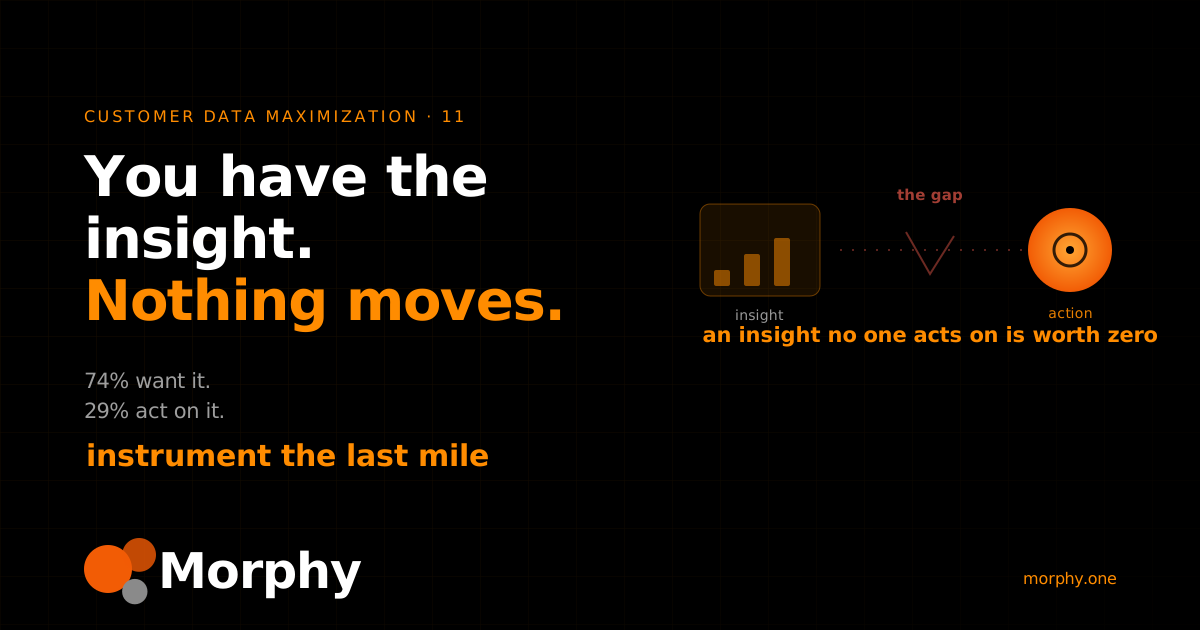
Insight never reaches action because reporting is treated as the finish line. The dashboard gets built, the insight gets celebrated, and nothing changes in-market. You close the activation gap by naming the decision every report should change, naming the owner who acts, and pushing data into the tools where work actually happens.
A quarterly review runs for ninety minutes. Forty charts, three analysts, one polished deck. Everyone nods, the meeting ends, and by Monday the campaigns run exactly as they did the week before. The insight was right. Nobody acted on it.
Why the insight stops moving
Most data programmes stop at the report. Building the dashboard feels like the deliverable, so that is where the effort ends. The chart goes up, the analysis circulates, and the work is declared done.
But a report is not a decision. It is a thing to look at. Between the insight appearing on a screen and someone changing a campaign, a price, or a segment, there is a gap that nobody owns. The analyst’s job ended at the chart. The operator’s job never started, because the insight never reached the tool they work in.
This is the last mile of data work, and it is the mile everyone skips. You can have perfect data, a correct model, and a beautiful dashboard, and still change nothing in-market. The distance between knowing and doing is where the revenue leaks out.
The danger is that awareness of this gap is low. Teams celebrate shipping the dashboard and never audit whether it changed a decision. The metric they watch is reports produced, not actions taken. So the gap stays invisible while everyone feels productive.
The evidence
Here is the whole problem in one number. 74% of enterprises want to be data-driven, but only 29% connect analytics insight to action (Forrester via CDP.com).
Read that again. Three in four organisations are investing in being data-driven. Fewer than one in three turn the insight into a change in-market. The gap is not a data problem or a tooling problem. It is an activation problem, and it is the norm, not the exception.
I saw the opposite discipline work at scale with the Cisco demand-generation engine, which ran to 628 million dollars in pipeline. The engine did not win because the reporting was prettier. It won because every insight fed straight back into the operational systems that ran the outreach. The loop was closed. The data did not stop at a dashboard.
Is this you?
Five quick checks. Answer each yes or no.
- Can you name a single in-market decision that changed because of last quarter’s dashboard?
- Does your team celebrate shipping a report, then never check whether it moved a decision?
- Do your best insights live in a reporting tool that the people doing the work never open?
- When an analysis lands, is it clear who owns the resulting action, or does it just circulate?
- Is your unified customer data sitting in a warehouse, unable to reach the campaign tools where it would earn its keep?
Three or more yes answers means you have an activation gap. The insight is being produced. It is just not being used.
What the gap costs
The cost hides because the reporting looks healthy. Charts are current, dashboards load, the data team is busy. Nothing signals failure.
But the spend is real. You pay analysts to produce insight that dies in a meeting. You pay for the warehouse, the pipelines, and the tooling that unify the data, then leave that unified view parked where no operator can act on it. Every insight no one acts on is money spent to reach a conclusion you then ignore.
It shows up as missed revenue too. The segment that should have been offered something different keeps getting the generic message, because the insight that flagged it never reached the campaign tool. The price that should have moved did not. The churn signal that was visible in the dashboard was visible to no one who could act.
And it compounds. The same instinct that keeps a vanity metric on the board deck, covered in why the MQL is costing you revenue, keeps unused dashboards alive. Both mistake reporting for outcome. You measure the thing you made, not the change it caused.
Instrument the last mile
The fix is not another dashboard. Adding reports to a team that already ignores its reports moves the insight-to-action ratio nowhere. You have to close the loop between the insight and the work.
Name the decision and the owner for every report. For each reporting asset you keep, write down the specific decision it should change and the single person who acts on it. If a report cannot name a decision, retire it. This one rule kills half your dashboards and makes the rest accountable.
Push data into the tools where work happens. Stop parking the unified customer view in a reporting layer. Send it back into the operational systems, the CRM, the ad platform, the email tool, through reverse ETL or closed-loop activation. This only works once your data is actually unified, which is why fixing fragmented customer data comes first. Acting on the insight should be the default path, not an extra step someone has to remember.
Measure actions taken per insight produced. Change the scoreboard. Count the decisions that moved, not the reports that shipped. An insight no one acts on has zero value, however accurate the analysis behind it. When the team is measured on action, it starts building for action.
Get the full activation gap playbook.
Close the loop, not the report
A dashboard is not the finish line. It is the halfway point. The value is created in the last mile, when an insight reaches the tool where someone works and changes what they do there.
So stop scoring yourself on reports produced. Score yourself on decisions changed. Name the decision, name the owner, and put the data where the work happens. The insight you already have is worth more than the next dashboard you build.
Go deeper on customer data maximization
Three ways forward. Pick the one that fits where you are.
- Get the playbook. Practical notes on turning the customer data you already own into revenue, straight to your inbox. Join the newsletter at the foot of this page.
- Take the assessment. Score your customer data maximization in four minutes and see your top revenue blockers. Start the assessment →
- Book a meeting. Bring your data problem. Leave with a prioritised fix, not a platform pitch. Book a call →
Post 11 of 25 in the Customer Data Maximization series. Previous: Why the MQL is costing you revenue, and what to measure instead. Next: Why do customers rate your personalisation worse than you do?.
Frequently asked questions
What is the activation gap?
The activation gap is the distance between knowing something and doing something about it. The data exists, the dashboard exists, the insight is correct, and nothing changes in-market. Forrester found 74% of enterprises want to be data-driven but only 29% connect analytics insight to action (Forrester via CDP.com).
Why doesn't building more dashboards close the activation gap?
Because the gap is not a reporting shortage. Most teams respond to weak activation by building more dashboards, and the insight-to-action ratio does not move. A new report adds another thing to look at, not another decision that gets made. The fix is to instrument the last mile, not widen the reporting layer.
What is reverse ETL and closed-loop activation?
Reverse ETL pushes data from your warehouse back into the operational tools where work happens, such as the CRM, ad platform, or email system. Closed-loop activation means the same insight that appears in a report also triggers or updates an action in those tools. The insight reaches the point of work, not just the point of viewing.
How do you measure whether insight leads to action?
Measure actions taken per insight produced. For every reporting asset, name the decision it should change and the owner who acts on it, then check whether that decision moved. An insight no one acts on has zero value, however accurate. Counting reports built tells you nothing about whether anything changed.
Where do you start closing the activation gap?
Audit one existing dashboard. Ask which in-market decision it changed last quarter and who owns that decision. If you cannot name one, you have found the gap. Then wire that insight into the tool where the work happens, so acting on it is the default, not an extra step.