
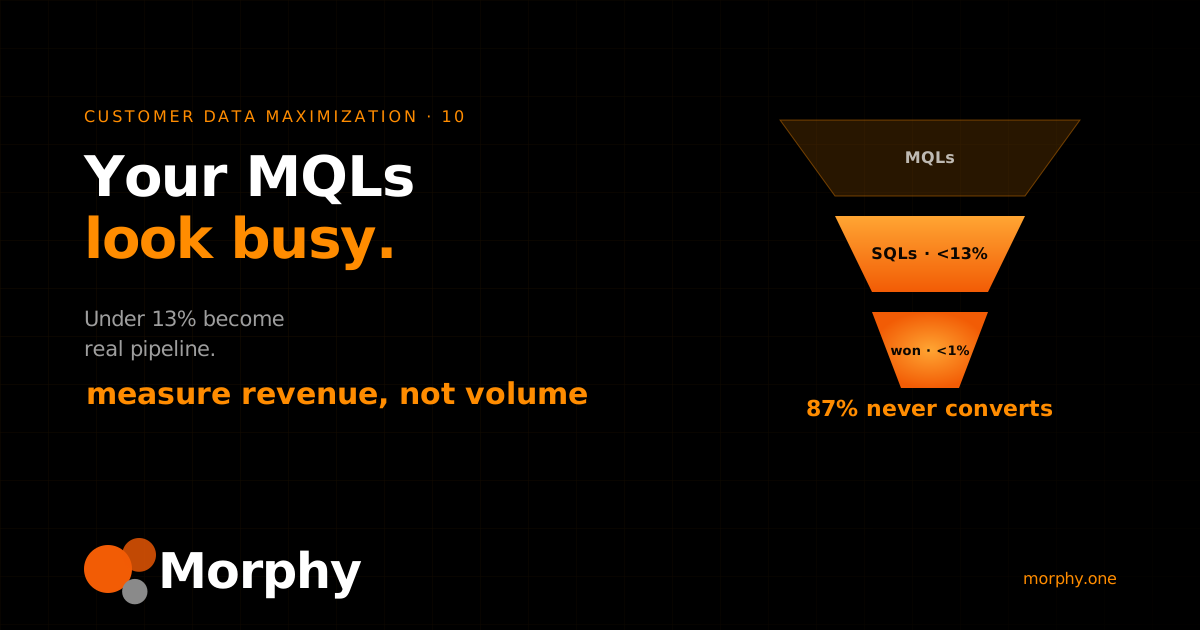
The MQL costs you revenue because it rewards volume the board cannot bank. Fewer than 13% of marketing-qualified leads convert to sales-qualified, and under 1% reach closed-won in many B2B funnels. Retire MQL volume as a board metric. Measure sales-qualified-lead conversion, pipeline sourced and influenced, and buying-group engagement instead.
A marketing team hits four thousand MQLs in a quarter and reports it to the board as a win. Almost none of them will ever close. Both facts sit in the same deck, and only the big number gets read aloud.
Why the MQL survives when everyone knows it is weak
The MQL is easy to produce. A contact fills a form, downloads a guide, crosses a score, and the number ticks up. You can always show it rising. That is exactly why it persists.
Harder metrics fight for the same slot and lose. Pipeline takes weeks to form. Conversion needs sales and marketing to agree on definitions. Buying-group engagement needs data most teams have not wired together. The MQL asks for none of that. It rewards activity you can generate on demand.
So the metric that is quickest to move becomes the metric that gets reported. The organisation then manages what it measures. It optimises for more MQLs, which means more form fills, which means more low-intent contacts that sales quietly ignores. The number goes up and the revenue does not.
There is a darker mechanism too. When MQL targets get tight, teams inflate them with downloads from the invisible part of the funnel: gated content grabbed by people who were never going to buy. That is the dark funnel leaking into your scorecard as fake progress.
The evidence
The conversion maths is brutal. Fewer than 13% of marketing-qualified leads convert to sales-qualified leads, and under 1% reach closed-won in many B2B funnels (Geisheker, 2026). You are reporting the top of a funnel where 99 in 100 go nowhere, and calling it performance.
The reporting problem compounds it. 6sense found that of roughly a dozen metrics a marketing team tracks, only two or three reach senior leadership, and only one or two of those reflect modern buying behaviour (6sense, 2025). The board sees a thin slice, and the wrong slice. MQL volume takes a seat that pipeline or conversion should hold.
The alternative is not theory. At Cisco I helped build the global inbound demand-generation engine to 628 million dollars in pipeline. Nobody in that room asked for the MQL count. They asked what pipeline marketing had created and what share of closed revenue it had touched. That is the metric that funds a marketing budget.
Is this you?
Five checks. Yes or no.
- Does MQL volume appear on the deck you take to the board?
- Can marketing and sales each state, without arguing, what turns an MQL into an SQL?
- Do you report pipeline that marketing sourced separately from pipeline it influenced?
- When a target account has six people engaging, does your reporting see one lead or the group?
- Has an MQL target ever been hit by chasing downloads you knew would not convert?
Three or more uncomfortable answers means your scorecard is measuring effort, not revenue.
What it costs
The cost is not the report. It is every decision the report drives.
Budget follows the metric. Fund MQL volume and you fund the campaigns that manufacture cheap form fills, not the ones that create pipeline. You buy more of the activity that converts worst.
Sales trust erodes next. When marketing celebrates four thousand MQLs and sales sees a trickle of real opportunities, the two teams stop believing each other’s numbers. Handover breaks. Good leads get treated like the junk that surrounds them.
Then attribution bends the wrong way. A funnel measured on lead volume credits whoever generated the most forms, not whoever moved the deal. You reward the loudest channel over the one that worked, the same failure that breaks cross-channel measurement.
None of this shows as a line item. All of it is real money, spent optimising for a number the board cannot bank.
What to measure instead
Three directions. Each ties marketing to revenue the business can count.
Anchor on sales-qualified conversion, not lead volume. Report how many MQLs become SQLs and how fast, then how many SQLs close. This turns marketing’s number into the same currency sales uses. MQL volume can survive as an internal operational metric. It just comes off the board deck.
Report pipeline sourced and pipeline influenced. Sourced pipeline is opportunity marketing originated. Influenced is opportunity marketing touched on the way to close. Together they answer the only question the board is really asking: what did marketing create, and what did it help finish?
Measure the buying group, not the lead. B2B deals are made by a committee, yet the MQL scores one contact at a time. Track how many people at a target account are engaging and how deeply. A single lead score cannot see a deal forming across six stakeholders. Group engagement can.
This is the shape of the fix, not the full method. Owners, definitions, and the exact board scorecard sit in the playbook.
Get the full MQL retirement playbook.
Go deeper on customer data maximization
Three ways forward. Pick the one that fits where you are.
- Get the playbook. Practical notes on turning the customer data you already own into revenue, straight to your inbox. Join the newsletter at the foot of this page.
- Take the assessment. Score your customer data maximization in four minutes and see your top revenue blockers. Start the assessment →
- Book a meeting. Bring your data problem. Leave with a prioritised fix, not a platform pitch. Book a call →
Post 10 of 25 in the Customer Data Maximization series. Previous: How do you measure marketing across offline and digital channels?. Next: Why does insight never reach action, and how do you close the activation gap?.
Frequently asked questions
What is an MQL and why is it a vanity metric?
A marketing-qualified lead is a contact that hit a scoring threshold, usually a form fill or content download. It is a vanity metric because volume looks like progress but rarely converts. Fewer than 13% of MQLs reach sales-qualified, and under 1% reach closed-won in many B2B funnels (Geisheker, 2026).
What should you measure instead of MQL volume?
Measure revenue-integrated outcomes: sales-qualified-lead volume and conversion, pipeline sourced plus influenced, and buying-group engagement. These tie marketing to money the board can bank. MQL volume can stay as an internal operational number, but it should not sit on the board deck.
Why does the MQL survive when everyone knows it is weak?
Because it is easy to produce. A form fill creates one instantly, so teams can always show the number going up. 6sense found that of roughly a dozen metrics tracked, only two or three reach senior leadership, and only one or two reflect modern buying behaviour (6sense, 2025). The easy metric wins the slot.
Is retiring the MQL a big technical project?
No. It is a reporting decision, not a system build. You already hold the data for pipeline and conversion in your CRM. Changing what appears on the board scorecard takes an agreement between marketing and sales, not a new platform or a quarter of engineering.
What is buying-group engagement?
B2B purchases are made by a group, not one person, yet the MQL scores one contact at a time. Buying-group engagement tracks how many people at a target account are active and how deeply, which reflects how deals actually close. It is a better signal than a single lead score.