
Your systems don’t talk because each was bought alone to do one job, with no shared model between them. Every disconnected tool becomes a fresh silo. You pay down the debt by standardising on API-first, modular tools and one shared data model, and by making interoperability a buying test rather than a hope.
Count the tools your marketing and data teams touch in a week. Then ask how many of them share a customer record automatically, with no export, no manual upload, no analyst stitching two files together at month end. The gap between those two numbers is your integration debt.
Why systems stop talking
Nobody sets out to build a disconnected estate. It grows one purchase at a time. A tool arrives to fix a specific job, it does that job, and it stores its data in its own shape behind its own screens. The next tool does the same. Neither was told about the other.
By the time you have dozens of tools, there is no shared model of a customer running underneath them. So teams bridge the gaps by hand. Someone builds a point-to-point connector from the email platform to the warehouse for one campaign. Someone else wires the loyalty tool to support for one project. Each link solves the day it was built for and nothing more.
Those connectors are the debt. They multiply, because every new pairing needs its own. They break, because each is bespoke and nobody owns the set. And they hide the real state of the estate, which looks joined from a distance and is held together by string up close.
This is why the debt rarely gets a single owner. The cost is diffuse. It shows up as an analyst’s lost afternoon here, a delayed campaign there, a report that does not reconcile. No one line item says “integration”, so no one is accountable for the total.
The evidence
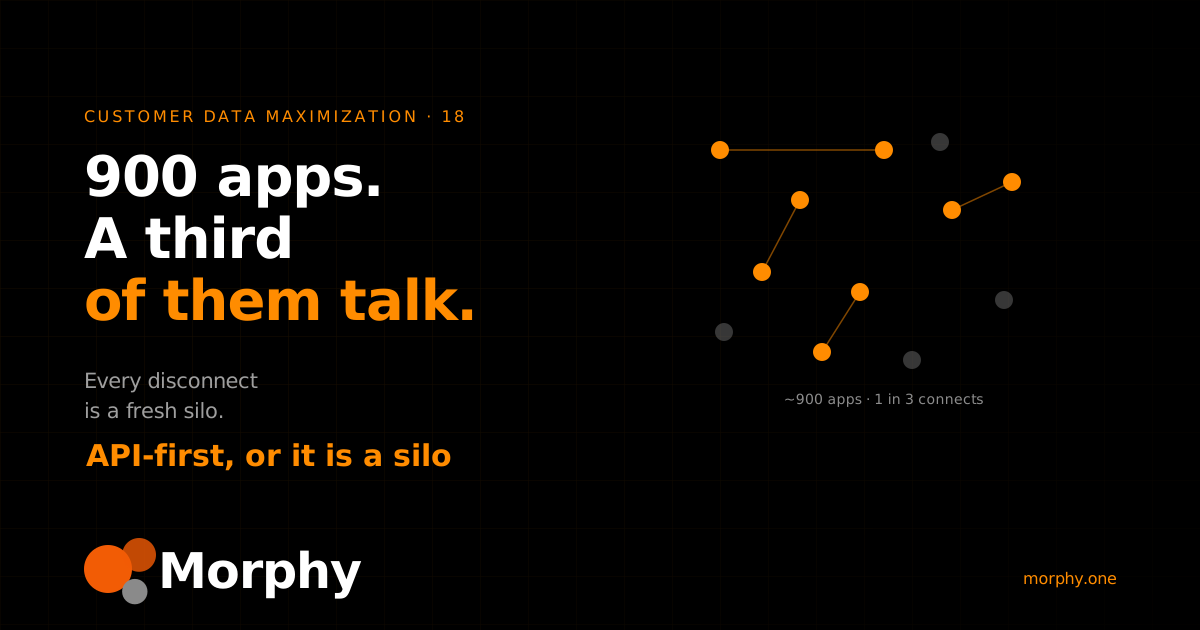
The average enterprise runs close to 900 applications, and only about a third of them connect (Netguru, 2025). Read that again. Two thirds of the software an organisation pays for cannot share data cleanly with the rest.
Every one of those disconnected systems is a fresh silo and a fresh point of failure. And the estate grows the wrong way by default. Each new tool added to close a gap widens the debt, unless it is chosen to integrate. Buy to fill a hole and you dig a deeper one.
I have run the connected version of this. The Cisco global demand-generation engine that fed a 628 million dollar pipeline only worked because the systems underneath it shared data, rather than trading exports. The pipeline number was the visible result. The plumbing was the actual achievement.
Is this you?
Five quick checks. Answer each yes or no.
- Does a routine campaign need someone to export from one tool and upload to another?
- When a system breaks, does a report or a customer view somewhere else quietly break too?
- Can anyone name how many custom connectors are running between your tools right now?
- Did your last tool purchase get chosen on features, with integration checked afterwards?
- Does month-end reporting depend on an analyst reconciling files by hand?
Three or more yes answers means integration debt is already taxing every team that touches data. You are paying the interest without seeing the loan.
What it costs
The cost of integration debt is real and mostly invisible, which is the worst combination.
It costs time. Skilled people spend their days moving data between systems that should move it themselves. It costs speed. A campaign that needs three tools to cooperate waits on the slowest manual bridge between them. It costs trust in the numbers, because every hand-off is a chance for a record to drift, and reports built on stitched data get argued with instead of acted on.
And it costs resilience. Point-to-point connectors are single points of failure. When one breaks, the break travels. A quiet change in one tool’s export format can take down a dashboard three systems away, and the person who owns the dashboard has no idea why.
There is a ceiling cost too. AI and real-time personalisation need clean, connected data to work. An estate where two thirds of systems cannot talk cannot feed them. So the debt does not just slow today’s work, it caps what you can build next.
Three directions that pay it down
You do not clear integration debt with one heroic project. You change how systems enter and connect, so the debt stops growing and then starts shrinking.
Standardise on a shared data model. Decide the shape of your core records, starting with the customer, and hold every system to it. New tools plug into that model rather than inventing their own. This is the same discipline as naming one master for fragmented customer data: the fix is a decision about structure, not a licence.
Buy API-first and modular. Prefer tools that expose their data and functions through stable, documented interfaces from day one. A tool whose data hides behind its own screens is a silo you are paying for. This is also the honest lesson behind why a CDP can become another silo: connection has to be built in, not bolted on.
Make interoperability a buying criterion. Put “does it connect to our live stack” on the scorecard before “does it have this feature”. A tool that cannot integrate adds debt no matter how good it looks in a demo. That single rule stops the estate growing the wrong way, and it is the antidote to the reflex to buy a tool for every gap.
The full sequence, including how to test a tool against your real stack before you sign, is in the playbook. Get the full integration debt playbook.
Make connection the default, not the exception
Integration debt is not a plumbing problem for the technical team to worry about. It is a design choice the whole business keeps making by accident, one disconnected purchase at a time.
Change the choice. Set the shared model, buy for connection, and refuse to add a tool that cannot prove it plugs in. Do that and the estate stops fighting you. Data moves on its own, people stop being the connectors, and the systems you already own finally start acting like one.
Go deeper on customer data maximization
Three ways forward. Pick the one that fits where you are.
- Get the playbook. Practical notes on turning the customer data you already own into revenue, straight to your inbox. Join the newsletter at the foot of this page.
- Take the assessment. Score your customer data maximization in four minutes and see your top revenue blockers. Start the assessment →
- Book a meeting. Bring your data problem. Leave with a prioritised fix, not a platform pitch. Book a call →
Post 18 of 25 in the Customer Data Maximization series. Previous: Why did your CDP become another silo, and what replaces it?. Next: Why does nobody own your martech stack, and what does it cost you?.
Frequently asked questions
What is integration debt?
Integration debt is the accumulated cost of systems that do not connect. Each disconnected tool becomes a fresh silo and a fresh point of failure. The average enterprise runs close to 900 applications and only about a third connect (Netguru, 2025), so most of the estate cannot share data cleanly.
Why don't my systems talk to each other?
Most were bought one at a time to solve one job, with no shared data model between them. Teams then bridge each gap with a point-to-point connector built per project. Those connectors multiply and break, so the estate looks joined but is held together by brittle links nobody owns.
How do you reduce integration debt?
Standardise on API-first, modular tools and one shared data model that new systems plug into. Stop building bespoke connectors per project. Treat interoperability as a buying criterion, not an afterthought, so every new tool has to prove it connects before it enters the estate.
Should interoperability be part of buying software?
Yes. Interoperability is a buying criterion, not an afterthought. A tool that cannot connect to your live stack adds debt no matter how good its features are. Test integration before purchase with a proof of concept against your real systems, not a demo environment.
What is an API-first tool?
An API-first tool is built so its data and functions are reachable through a documented, stable interface from day one, not bolted on later. It plugs into a shared data model instead of hiding data behind its own screens. That makes it a system that connects, rather than another silo.