
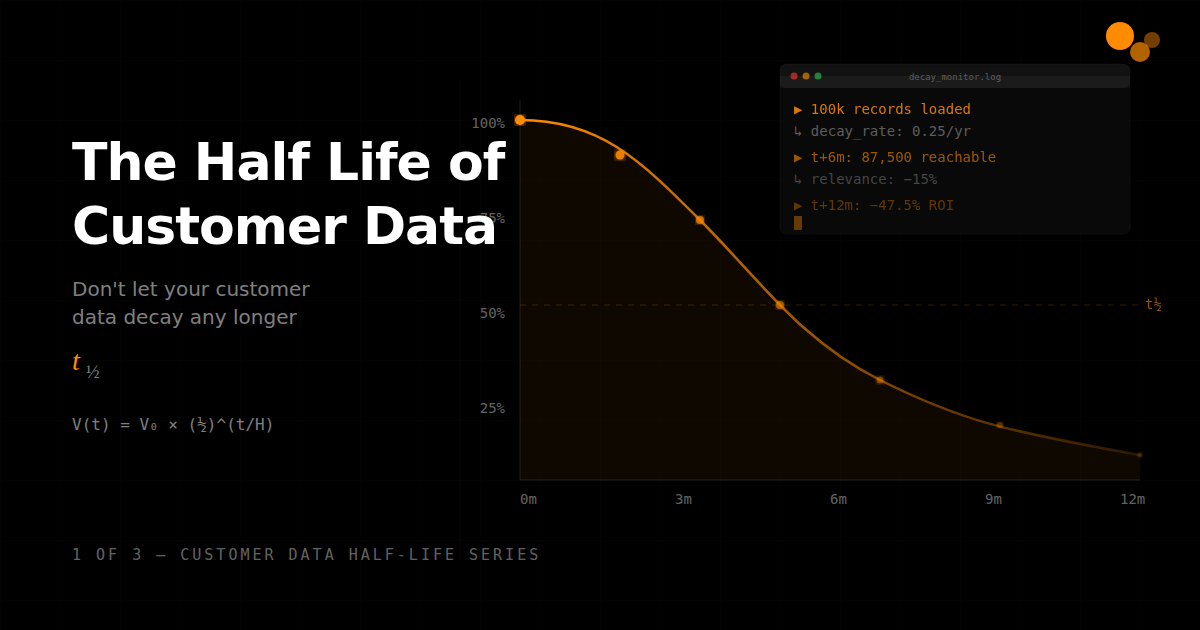
By this time next year, a quarter of the email list you are paying to store will be dead. Not unsubscribed. Dead. Hard bounces. Closed mailboxes. People who changed jobs and never looked back. ZeroBounce measured it at 23% annual decay in 2025. HubSpot and MarketingSherpa put monthly churn at 2-3%.
That is not a storage problem. It is a value problem. Every record in your CRM was worth something on the day it arrived. Today, some fraction of those records can no longer reach a living inbox. You are paying to store, query, and run compliance against data that cannot generate a dollar.
Data has a half-life
Doug Laney coined the term “Infonomics” in 2018 while at Gartner. His thesis: data is an asset. It can be measured, valued, and managed like inventory. Accountants depreciate machines on a straight line. Data does not work that way. It decays exponentially. The further you sit from the moment of capture, the less the data can do for you.
The mechanism is simple. People change jobs. They move house. They abandon email addresses. Their intent shifts between Tuesday and Thursday. The signal you captured last week is weaker today than it was the morning after.
This is not controversial. Everyone in a data team knows it intuitively. Almost nobody prices it into their planning. The data sits in the warehouse looking exactly the same whether it was captured yesterday or eighteen months ago. Nothing in the schema tells you it is dying.
The taxonomy: long, medium, short
Not all data decays at the same rate. The half-life depends on what the data is tied to.
| Half-life | Data type | Why | Rough useful life |
|---|---|---|---|
| Long | Date of birth, full name, gender, personal email | Tied to the person | Years to decades |
| Medium | Work email, postal address, job role | Tied to employment; median US tenure ~3.9 years (BLS, Jan 2024) | 2-3 years; ~25% gone by year 1 |
| Short | Site visit, expressed intent, cookie ID, last order | Tied to session or purchase cycle | Days to weeks |
Most CRM and marketing databases are dominated by medium-half-life data. Work emails. Job titles. Company names. Office addresses. These fields feel stable because they do not change every day. But they change fast enough to destroy campaign economics within a year.
Landbase (2026) tracked 1,000 B2B contacts over 12 months. Result: 70.8% changed at least one field. Not a typo. Seven out of ten records drifted in under a year. That is not edge-case churn. That is the baseline for any B2B database that is not actively maintained.
Short-half-life data is worse. A site visit that signalled purchase intent last Monday is nearly worthless by next Monday. The buyer moved on. The budget cycle turned. Someone else won the deal. If you are sitting on “hot leads” from three weeks ago, they are no longer hot. They are room temperature.
The decay hits you twice
The obvious hit is quantity. You paid to acquire 100,000 contacts. Twelve months later, 25,000 of those addresses hard-bounce. Your reachable universe shrank by a quarter while you were running approval cycles.
The less obvious hit is relevance. The records that still reach a real person are weaker. The offer you built for “Head of Marketing at a Series B fintech” now reaches someone who moved to a Series D enterprise six months ago. Their inbox is different. Their priorities are different. They still open your email. They just do not convert.
Most campaign ROI models account for the first effect (list hygiene, bounce rate) and ignore the second entirely. That is where the real margin disappears.
A simple heuristic for modelling the combined effect:
V(t) = V₀ × (½)(t / H)
Where V₀ is starting campaign value, t is time elapsed, and H is the half-life for that data type. This is a planning heuristic, not a physics law. Its job is to force a conversation about speed.
Worked example: 100,000 work emails
Start with 100,000 work email addresses. Assume a 1% conversion rate and $10 average revenue per conversion. Day-one campaign value: $10,000.
Effect 1: Quantity decay.
At 25% annual attrition (ZeroBounce), 75,000 records are reachable after 12 months. Your campaign ceiling drops from $10,000 to $7,500 before you write a single word of copy. Pure arithmetic. Nothing you do in creative or targeting recovers the 25,000 addresses that no longer exist.
Effect 2: Response decay.
The 75,000 remaining addresses are twelve months older. Job roles shifted. Budgets reallocated. Priorities moved. Conversion rate drops from 1.0% to roughly 0.7% [Assumption: illustrative, based on typical B2B campaign degradation over time]. That gives you 525 conversions instead of 750. Revenue: $5,250.
Combined loss: $10,000 down to $5,250 in 12 months. A 47.5% value drop from a list you are still paying full price to maintain. You are serving those 100,000 records in every query, backing them up nightly, running GDPR compliance against all of them. The cost is flat. The yield is halved.
Landbase estimates poor data quality costs US businesses roughly $3.1 trillion per year. That figure is large enough to feel abstract. The email example is not. Run the same arithmetic against your own list size, your own conversion rate, your own revenue-per-action. The number will not be comfortable.
Why companies act too slowly
Three causes show up repeatedly:
- Collection is disconnected from activation. The team that builds the form is not the team that runs the campaign. Data enters a warehouse. Weeks pass. A brief is written. By the time the campaign hits production, the data is months old.
- Quarterly planning cycles. A signal captured in January sits in a dashboard until March planning, gets approved in April, goes live in May. Four months of decay baked into the process by design. Nobody decided to wait. The calendar decided for them.
- No decay model exists. Without a half-life framework, every record looks equally valid in the CRM. Old data and fresh data sit in the same table with the same priority. The system treats a two-year-old work email the same as one captured yesterday.
Post 2 in this series will unpack each of these and show what replaces them.
The one move: plan the campaign before you collect the data
The highest-value fix is not better data hygiene. It is not enrichment vendors. It is not deduplication sprints. It is timing.
If you know the campaign before you capture the signal, you can act within days of collection. The data is at peak value. Reachability is at its highest. Relevance is at its highest. You capture and convert in the same motion, before the half-life begins to bite.
This means designing the activation before you design the capture. What will you do with this data within 72 hours of receiving it? If the answer is “put it in the warehouse and figure it out later,” you have already lost a chunk of its value.
Landbase found that clean, current data produces roughly 20% better campaign response rates and 15% higher close rates compared to aged lists. Those lifts are not from better creative or smarter segmentation. They are from acting on data before it decays.
The operating principle: treat every data capture as a countdown. The moment a record enters your system, a clock starts. Your job is to activate it before the half-life cuts its value in half. Everything else is optimizing a diminishing asset.
What to do next
Want to know which of your data assets are already past their half-life? Book a data half-life review. We will map your active datasets against the taxonomy above, estimate current decay rates from your own bounce and engagement data, and identify where you are spending budget on data that can no longer convert.
This is Post 1 of 3 in the Data Half-Life series.
Next: the playbook. How to act on a signal before it decays, without calling a meeting.
Working on a similar problem?
Book a discovery call