
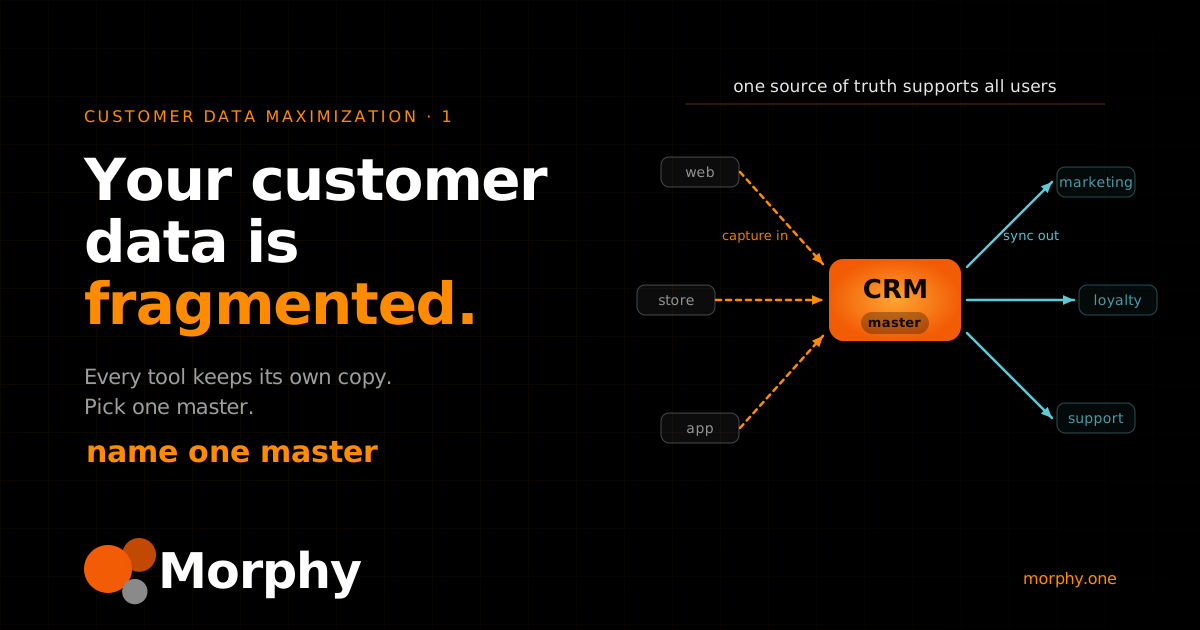
Customer data fragments because every tool you buy ships its own customer table, and every channel drops customers into its own store. Nobody decides which one is the truth. You fix it by naming one master CRM, one warehouse, and resolving records on deterministic keys you can trust.
Ask two teams in the same company how many customers they have. You will get two answers. Sometimes three. Nobody is lying. They are each reading a different system, and no two systems agree.
Why does customer data fragment in the first place?
Every new tool ships with its own customer table. The CRM has one. The loyalty platform has another. Billing keeps a third. Support runs a fourth. Each was bought to solve one job, and each solved it by storing its own copy of the customer.
Then channels widen the gap. A customer who buys in-store lands in one store of record. The same person buying online lands in another. Nobody reconciles them. That is where duplication is born.
So support sees one version of the customer. Loyalty sees another. Billing sees a third. There is no single view, only a set of partial ones, each confident it is complete.
The usual response is to buy a customer data platform or an integration layer and declare the silos gone. They are not. A CDP bolted onto fragmented sources becomes one more fragmented source. It reads the same conflicting inputs and hands you back the same conflicts, faster.
The evidence: the problem is widening, not closing
68% of data leaders say siloed customer data is their single biggest problem. That number rose last year, not down (DATAVERSITY, 2024). Budgets are pouring into data platforms while the core problem gets worse. The tools are not the fix. The decision is.
I have built the other version of this. At dunnhumby we ran Tesco Clubcard as the spine, with roughly 12 million records connected back to one master. That discipline is what let us launch a financial-services line that went from zero to 63 million dollars in twelve months. The win did not come from a new platform. It came from deciding what the master was and connecting everything to it.
Is this you?
Five quick checks. Answer each yes or no.
- Do two teams quote different customer counts for the same segment?
- Does one customer receive the same offer twice through different channels?
- Can you name, right now, which system is the source of truth for a customer’s email?
- When a customer changes address, do you know how many systems still hold the old one?
- Has a single customer view project stalled, or been quietly shelved?
Three or more yes answers means fragmentation is already costing you money. You just are not seeing the invoice.
What fragmentation actually costs
The cost hides in plain sight because no line item is labelled “silos”.
It shows up as firefighting. Analysts spend days reconciling exports by hand before a campaign can run. It shows up as waste. You pay to reach the same person three times because three systems each think they own them. It shows up as mis-attribution. Revenue lands in the wrong channel’s column, so you fund the channel that shouted last, not the one that worked.
And it shows up as risk. When a customer asks what you hold on them, you cannot answer with confidence, because the honest answer is that you do not fully know.
None of this appears in a budget. All of it is real money.
Three moves that actually work
I have done this inside large loyalty and retail businesses. The sequence is boring, which is why most teams skip it.
Pick one master. Where billing sits is your master CRM. Billing is where identity is verified with money, so it holds the cleanest link between a person and what they did. One CRM as the spine. One warehouse that takes a copy, or reads through a lakehouse pattern. Everything else defers to the master.
Get the keys right. Email is your primary key, so protect its quality at capture. Company-domain email links people at the same employer, imperfect but useful, so keep personal and work email separate. Precise address matching links a household. These are deterministic keys. Trust them over any probabilistic guess a vendor graph offers you.
Appoint an owner. Integration makes data usable. It does not decide your master, and it does not hold quality over time. That needs a named person or team who owns data quality and governance across every touchpoint, with the one CRM as the spine. It costs an org-chart line, not a licence.
Here is the part most consultants will not tell you. Some records will never reconcile. Draw the Venn diagram of your systems and look at the overlap. Work the records that resolve today, and use them now. Do not wait for a perfect single view. Perfection is the enemy of revenue.
Start with the decision, not the tool
Fragmentation is not a technology problem wearing a technology costume. It is a decision nobody has made: which system is the truth, and who owns keeping it true.
Make that decision first. The integration work gets simpler once there is a master to integrate toward. The keys get cleaner once someone owns them. And the single customer view stops being a two-year programme and starts being a thing you improve every week.
Identity is the next layer down. Even with one master named, you still have to link a person to themselves across email, device, and household. That is identity resolution, and it is where the real leverage sits.
Want the full operating sequence? Get the fragmented-data playbook: the three-step fix, who owns each move, and how to train the team to hold it.
Go deeper on customer data maximization
Three ways forward. Pick the one that fits where you are.
- Get the playbook. Practical notes on turning the customer data you already own into revenue, straight to your inbox. Join the newsletter at the foot of this page.
- Take the assessment. Score your customer data maximization in four minutes and see your top revenue blockers. Start the assessment →
- Book a meeting. Bring your data problem. Leave with a prioritised fix, not a platform pitch. Book a call →
Post 1 of 25 in the Customer Data Maximization series, on getting revenue from the customer data you already own. Next: Identity resolution, and how to fix it.
Frequently asked questions
What does fragmented customer data mean?
Fragmented customer data means the same customer exists as separate, unlinked records across different systems. The CRM holds one version, the loyalty platform another, billing a third. No system is agreed as the source of truth, so every team works from a different number.
Why does buying a CDP not fix data silos?
A customer data platform bolted onto fragmented sources becomes one more fragmented source. It reads the same conflicting inputs and inherits their conflicts. Integration makes data usable, but it does not decide which system is your master. That decision is a leadership call, not a purchase.
Which system should be the master for customer data?
Make the system where billing sits your master CRM. Billing is where identity is verified with money, so it holds the cleanest link between a person and what they actually did. One CRM as the spine, one warehouse taking a copy or reading through a lakehouse pattern.
What is deterministic identity resolution?
Deterministic resolution links records using keys you can trust rather than guess. Email is the primary key. Company-domain email links colleagues at the same employer. Precise address matching links a household. These are facts, not probabilities, so you can act on them today.
How do you start fixing fragmented customer data?
Name one master system. Get the connecting keys right, starting with verified email. Appoint a person or team to own data quality across touchpoints. Then work the records that reconcile today rather than waiting for a perfect single view that never arrives.