
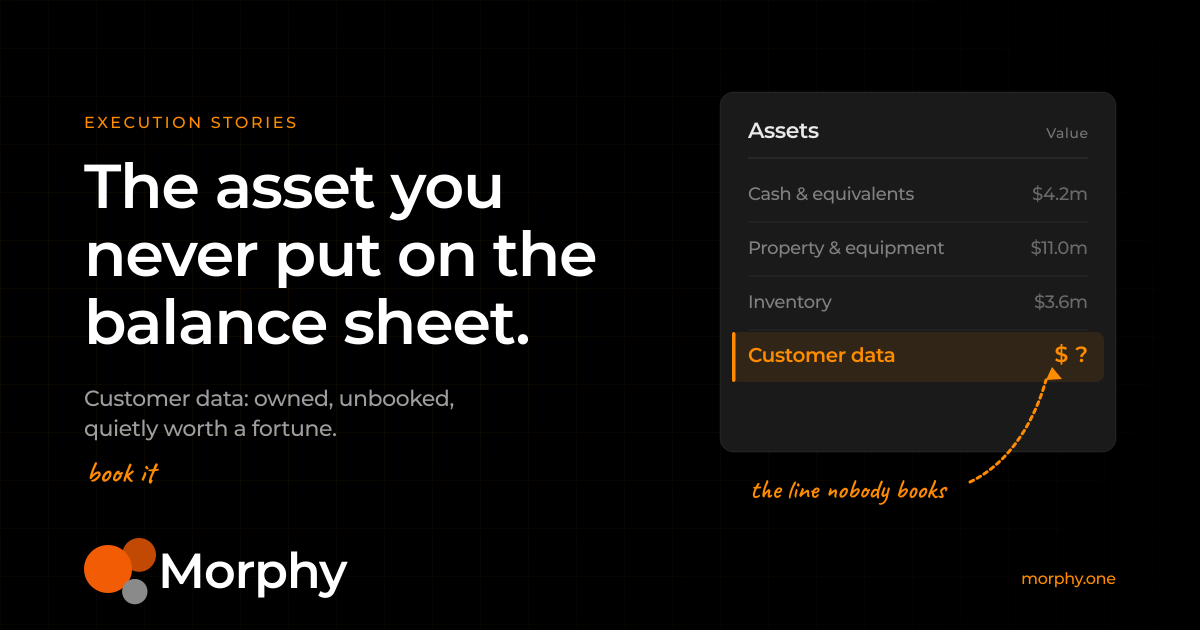
Ten years ago, Gartner made a promise on behalf of every company with a database. By 2020, it said, one in ten organisations would run a profitable business unit built on selling their own information. A neat idea, with a name: infonomics. I wrote about it at the time with some enthusiasm. The deadline came and went. Almost nobody built the unit.
I’ve spent the years since watching why, up close, in the Clubcard years at dunnhumby and later running enterprise sales and marketing at Oracle. The answer is not the one most people reach for. It wasn’t the technology. The tools to store, blend and sell data have been cheap and good for a decade. The reason is duller and more human: companies started from the data they had, not the need someone would pay to meet. They went looking for a problem in the spreadsheet and worked backwards. That almost never sells.
Here’s the part that should worry you in 2026. The last excuse just disappeared.
For years you could blame the plumbing. The data sat in seven systems, nobody could join it, the good stuff needed a data engineer you didn’t have. Fair enough. But a model can now read across those seven systems, find the customer hiding in all of them, and tell you in plain English what they’re about to do. Activation costs a fraction of what it did. Work that used to take a team a quarter takes an afternoon. And still the data rots. Owning it and using it remain two completely different things, and the entire gap between them is where the money sits.
Let me give you a real example, because the principle is useless without one.
Years ago I worked with a company’s training team. They’d run product courses for thousands of engineers from other firms, and kept careful records of every attendee. Dead data, as far as anyone was concerned: a compliance file. Two things were true about it that nobody had noticed. First, those junior engineers had grown up. They were now the people signing off IT budgets, and they had warm history with the brand. Second, recruiters and trade media pay real money to reach senior technical people, and here were thousands of them, named and qualified. The same dusty file was both a sales list and a sellable product. The data hadn’t changed. The question asked of it had.
That’s the whole discipline, and it inverts how most teams work. Don’t start with “what’s in our data?” Start with “who has a need, and what would they pay to have it met?” Then go and see whether your data can meet it. Demand first, mining second. If you can’t name the buyer, inside the business or out, before you start, don’t start. You’ll produce a beautiful dashboard nobody opens.
So if you run a small team, with a smaller budget and a database you’ve barely touched, here’s where I’d point you.
Look in the boring places first. The marketing list, the support tickets, the transaction log, the usage data your product quietly throws off every day. The valuable asset is rarely the exotic one. It’s the ordinary one you’ve stopped seeing.
Value it like an asset, not a by-product. What would it cost to access and clean? Who needs it, inside and out? Are you the only one who holds it, because scarcity, not volume, sets the price. And does it perish? Intent data is worth a fortune on Tuesday and nothing by Friday.
Then make something happen with it. This is where most of these projects die. A buyer invests once, sees nothing change, and walks. The point was never the insight. It was the action the insight triggers, at scale, for thousands of people at once, every time, without forgetting. That, finally, is the thing AI is genuinely good at. Not finding the insight. Doing something with it, reliably, on repeat.
None of this is a technology project. It’s a habit. The companies that own the next ten years won’t be the ones with the most data, or the best model. Plenty have both and do nothing. They’ll be the ones who start from a need worth meeting and treat their own data as the asset it has always been, sitting on a balance sheet that has never booked it.
Gartner’s deadline was wrong by at least a decade. The opportunity wasn’t. It has just been waiting for everyone to stop staring at the data and start asking who needs what.
Working on a similar problem?
Book a discovery call