
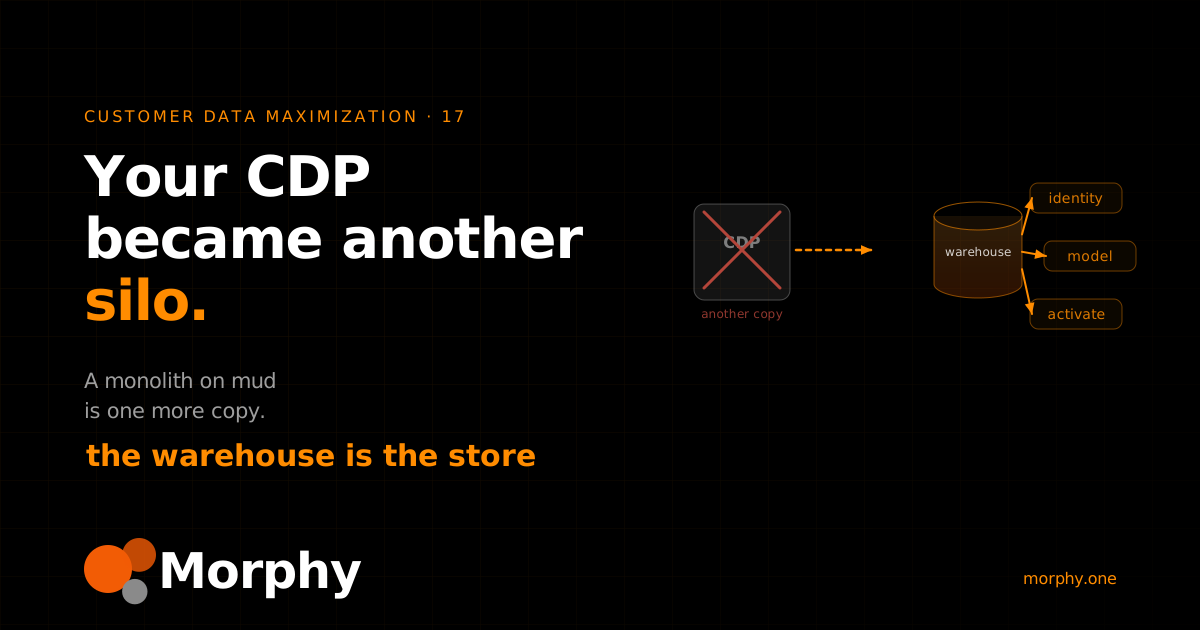
Your CDP became another silo because you layered it onto fragmented systems. It reads partial data and stores its own copy of the customer, so it drifts from the truth like everything else. You fix it with composable architecture: make the data warehouse the single store, and run identity, modelling, and activation as services on top of it.
You bought the CDP to end the arguments about which number was right. Two years on, the CDP is the number people argue about. It sits beside the CRM and the warehouse, holding a third version of the customer, trusted no more than the other two.
Why your CDP became a silo
The pitch was a single view. Buy one platform, pipe every source into it, and finally see the whole customer. The logic held right up until the data arrived.
Because the sources were already fragmented. The CDP did not fix that. It ingested it. It copied conflicting records out of the CRM, the loyalty platform, and billing, built a profile from those partial inputs, and stored the result in its own tables. That store then aged on its own timeline, separate from the systems it copied.
So you did not remove a silo. You added one. A well-marketed silo with a good dashboard, but a silo all the same. It holds a copy that drifts, and the moment a source updates, the CDP is wrong until the next sync.
CDPs increasingly become part of the silo problem they were bought to solve: layered onto fragmented systems, they hold partial profiles and form one more isolated store (Netguru, 2025). The monolithic CDP promised a single view and frequently delivered another copy.
The evidence
The waste starts with what you feed it. Poor data quality wastes roughly 21% of marketing budgets, and a CDP fed dirty data inherits that waste rather than curing it (Netguru, 2025). A platform cannot clean data it never governed. It stores what you give it, faster and at scale, errors included.
This is the same trap as fragmented customer data. A tool bolted onto conflicting sources becomes one more conflicting source. The CDP did not break that rule. It proved it again, with a bigger licence.
Is this you?
Five quick checks. Answer each yes or no.
- Does your CDP hold a customer count that matches neither the CRM nor the warehouse?
- When a source system updates, is there a lag before your CDP reflects it?
- Did you buy the CDP to create a single view, and still not have one?
- Are you running identity matching inside the CDP on probability rather than verified keys?
- Has anyone proposed buying a second, bigger CDP to fix the first?
Three or more yes answers means your CDP is a store that drifts, not a source of truth.
What it costs
The cost hides because the platform looks like progress. You have a customer data platform. The box is ticked. The bill is paid.
Underneath, the drift costs you three ways. It costs accuracy, because activation fires on a copy that is hours or days behind the real record. It costs trust, because teams learn the CDP is often wrong and quietly go back to exporting from source. And it costs the next licence, because the reflex when the CDP disappoints is to buy a bigger one and repeat the mistake at a higher price.
None of that shows as waste on a report. All of it is money spent to recreate the problem you were solving.
What composable actually means
The answer is not a better platform. It is a different shape. Stop copying the customer into a store that drifts. Read the customer where it already lives.
Make the warehouse the single store. Your data warehouse holds the data already. Make it the one place the customer lives, and stop shipping copies into a separate CDP. Composable customer data architecture assembles the platform from modular services on top of that store: identity resolution, modelling, and activation as components, not one monolith. The market is moving this way for a reason.
Resolve identity deterministically. Match records on keys you can trust, starting with verified email, not on a probability score. Probabilistic matching stitches the wrong people together, and a CDP activates those errors at scale. This is the same discipline as identity resolution: deterministic first, because you can defend it.
Precompute audiences, and let the view run the system. Build your segments in the warehouse ahead of time rather than scanning millions of rows at query time. The view becomes the operational system that activation reads directly, not a copy that has to be synced and reconciled. When the warehouse updates, the audience is already current.
That is the shape of it. The full sequence, with owners and what to measure, is the playbook. Get the full composable CDP playbook.
Stop buying the copy
Disillusionment with the CDP is not a sign you bought the wrong platform. It is a sign the monolithic shape was wrong. A store that copies the customer will always drift from the customer.
Composable architecture removes the copy. The warehouse holds the truth, the services read it, and the single view stops being a product you buy and starts being the way your data already works. That path runs straight into the wiring underneath it: getting systems to talk without another copy is integration and interoperability debt, the next obstacle down.
Go deeper on customer data maximization
Three ways forward. Pick the one that fits where you are.
- Get the playbook. Practical notes on turning the customer data you already own into revenue, straight to your inbox. Join the newsletter at the foot of this page.
- Take the assessment. Score your customer data maximization in four minutes and see your top revenue blockers. Start the assessment →
- Book a meeting. Bring your data problem. Leave with a prioritised fix, not a platform pitch. Book a call →
Post 17 of 25 in the Customer Data Maximization series. Previous: You use half your martech. How to get revenue from the stack you own. Next: Why don’t your systems talk, and how do you pay down integration debt?.
Frequently asked questions
Why did my CDP become another silo?
A CDP layered onto fragmented systems reads partial data and stores its own copy of the customer. It holds a profile built from incomplete inputs and becomes one more isolated store, adding to the silo problem it was bought to solve (Netguru, 2025).
What is a composable CDP?
A composable CDP is customer data architecture assembled from modular services on top of your data warehouse. The warehouse is the single store. Identity resolution, modelling, and activation run as separate components that read it directly, rather than copying data into a monolithic platform that drifts.
Does a CDP fix data quality problems?
No. A CDP inherits the quality of the data you feed it. Poor data quality wastes roughly 21% of marketing budgets, and a CDP fed dirty data inherits that waste rather than curing it (Netguru, 2025). Fix quality at source before you copy anything anywhere.
Why should identity resolution be deterministic in a CDP?
Deterministic identity links records on keys you can trust, like verified email, not probabilistic guesses. Probabilistic matching stitches wrong people together, and a CDP built on it activates those errors at scale. Deterministic matching keeps the profiles you act on defensible.
What does composable architecture replace in a monolithic CDP?
It replaces the copy. A monolithic CDP ingests data into its own store, which drifts from the warehouse over time. Composable architecture makes the warehouse the operational system and precomputes audiences there, so activation reads the current truth rather than a stale duplicate.