
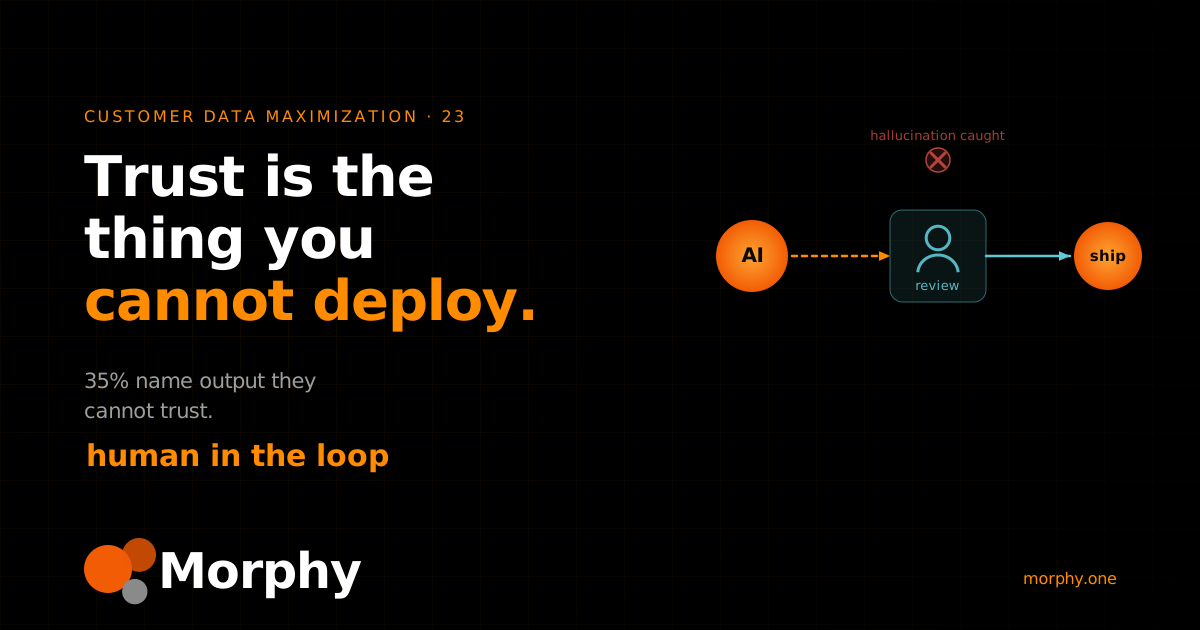
AI output you cannot trust cannot be deployed to customers unsupervised. That caps the value AI returns. The fix is not more caution. It is AI governance as a function: provenance rules that trace every claim, human review on customer-facing output, and explainability where a decision affects a person.
A model writes a confident paragraph. Half of it is correct. You cannot tell which half without checking. So you check everything, or you keep the model away from customers. Both choices waste the thing you bought.
Why trust is the blocker, not the technology
The models work. They summarise, draft, classify, and answer at a level that would have looked like magic five years ago. The problem is not capability. It is that a generative model can be fluent and wrong at the same time, and it gives you no signal about which.
This is hallucination. The model fills a gap with something plausible because plausible is what it was trained to produce. In an internal draft, that is a minor edit. In a message to a customer, a price, or a service decision, it is a liability you cannot see until it lands.
So teams do the rational thing. They pull AI back to low-stakes internal tasks where an error costs a redraft, not a customer. That feels safe. It is also where the value is smallest. The upside sits in customer-facing work: personalisation, service, offers, the moments that move revenue. Trust is the gate between the two, and right now the gate is shut.
The evidence
35% of organisations name output they cannot fully trust, including hallucination, as their biggest AI challenge. That puts trust ahead of the skills gap at 30% and security at 29% (HubSpot, 2025). The named blocker is not that people cannot use AI, or that it is unsafe to run. It is that they cannot rely on what it says.
Read that ordering carefully. More teams are stuck on trust than on talent or security. It means the constraint on AI value is no longer building the thing. It is being able to stand behind the output when a customer reads it.
Is this you?
Five quick checks. Answer each yes or no.
- Is your AI confined to internal drafts because you will not put its output in front of a customer?
- When a model makes a claim, can you trace what data fed it?
- Does a person review AI output before it reaches a customer, by rule and not by habit?
- If a customer challenged an AI-driven decision, could you explain why the model decided that?
- Has an AI pilot stalled at “impressive, but we cannot ship it”?
Three or more answers on the wrong side means trust, not technology, is capping your return.
What it costs
The cost of untrusted AI is the value you never collect. You paid for a capability and then fenced it off from the work that would pay it back.
It shows up as capped upside. The model that could answer customers is stuck writing internal memos, so the return stays a fraction of what it could be. It shows up as duplicated effort. Every AI output gets re-checked by a human from scratch, because there is no rule for what needs review and what does not, so you carry the cost of AI and the cost of the manual work it was meant to replace.
It shows up as stalled pilots. Projects that demo well die at deployment because nobody can sign off on output they cannot trust. And it shows up as risk when someone ships anyway, without checks, and a confident error reaches a customer with your name on it.
None of this is a model problem. All of it is a governance gap.
Three directions that build trust
You do not fix trust with better prompts. You fix it by governing what the model can do and proving what it did. Three moves start that.
Set provenance rules. Control what the model draws on and trace every claim back to a source. If an answer cites your data, you should be able to see which record fed it. Provenance is what turns “the AI said so” into “here is why,” and it is the difference between an output you can defend and one you can only hope is right.
Put a human on customer-facing output. Not every task, and not by habit. By rule. Decide which output classes reach a customer, and require review on those before they ship. This is human-in-the-loop as a control, not a bottleneck: the model does the volume, the person owns the judgement where judgement matters.
Demand explainability where decisions affect people. If a model shapes an offer, a price, or a service action, you must be able to say why in terms a person can check. A decision you cannot explain is one you cannot correct, and one you cannot defend when a customer or a regulator asks.
These are the surface. The full operating sequence, with owners and what to measure, is in the playbook.
Get the full AI trust and governance playbook.
Governance is what lets you deploy further
Here is the reframe that changes the economics. Governance is not a brake on AI. It is the thing that lets you deploy it where the value is.
The same enablement framing fixes obstacle 4. Governance that drives revenue is not the department that says no. It is the function that makes it safe to say yes to bigger uses. Provenance, review, and explainability are not there to slow AI down. They are what let you move it out of the internal sandbox and in front of customers, which is the only place the returns are large.
This assumes your data is in a state the model can use, which is AI data readiness, the obstacle before this one. And a governed system still needs people who can run it, which is the talent and skills gap that comes next.
Stand governance up as a function. Then deploy AI where it pays, with checks that let you sleep.
Go deeper on customer data maximization
Three ways forward. Pick the one that fits where you are.
- Get the playbook. Practical notes on turning the customer data you already own into revenue, straight to your inbox. Join the newsletter at the foot of this page.
- Take the assessment. Score your customer data maximization in four minutes and see your top revenue blockers. Start the assessment →
- Book a meeting. Bring your data problem. Leave with a prioritised fix, not a platform pitch. Book a call →
Post 23 of 25 in the Customer Data Maximization series. Previous: Is your data ready for AI?. Next: Why can’t your team run the tools you bought?.
Frequently asked questions
Why can't you trust AI output enough to deploy it?
Because generative models can produce fluent output that is wrong, and you cannot always tell which is which. 35% of organisations name output they cannot fully trust, including hallucination, as their biggest AI challenge (HubSpot, 2025). Output you cannot trust cannot go to customers unsupervised.
What is AI governance as a function?
AI governance is a named function that decides where AI output can go and under what checks. It sets provenance rules so you can trace what fed a claim, mandates human review on customer-facing output, and requires explainability where a decision affects a person. It is a function, not a policy document.
How do you govern AI hallucination?
You govern hallucination by controlling what the model can draw on, checking output before it reaches a customer, and tracing every claim to a source. Provenance rules tell you what fed an answer. Human review catches the confident errors. Neither is optional for customer-facing output.
Does restricting AI to internal tasks solve the trust problem?
It hides the problem, at a cost. Keeping AI on low-stakes internal work avoids the risk but caps the value AI can return. The upside sits in customer-facing use. Governance is what lets you deploy there safely, so it expands what you can do rather than shrinking it.
What is explainability in AI, and when do you need it?
Explainability means you can say why a model produced a given output in terms a person can check. You need it wherever a decision affects a customer: a declined offer, a price, a service action. Without it, you cannot defend the decision or correct it when it is wrong.