
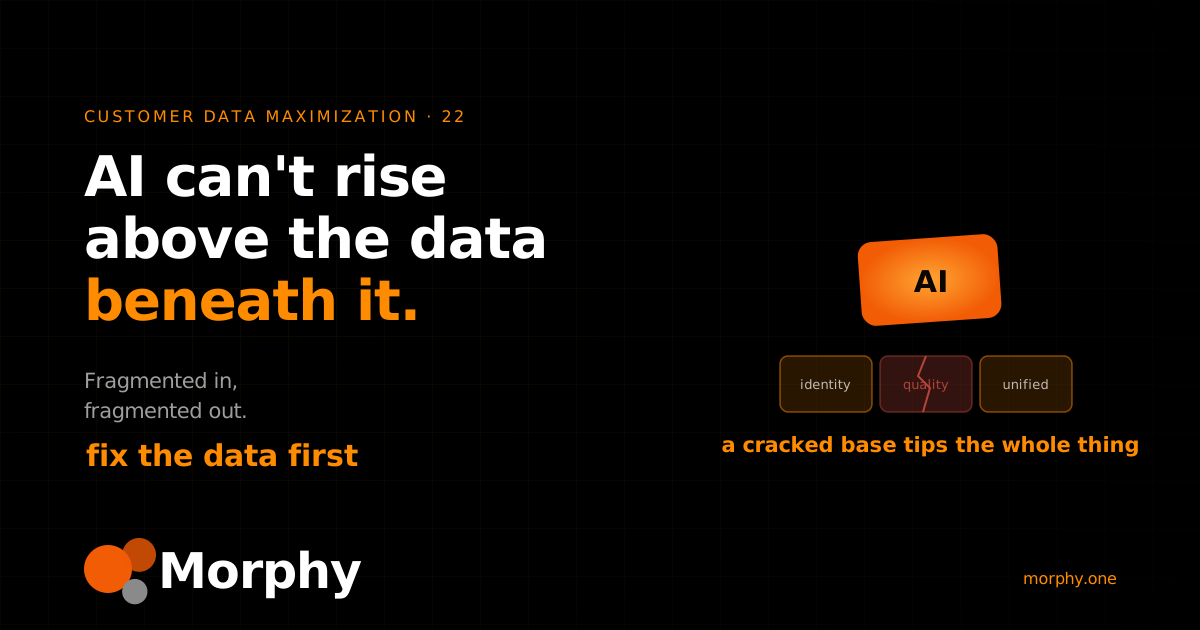
Most AI projects stall in pilot because the data underneath was never ready. AI does not transcend the data it is fed. Give it fragmented, unresolved, dirty data and it scales the mess. The fix is to treat data readiness as the precondition for AI spend, not a parallel workstream you run later.
A team runs an AI pilot on a clean sample. It works. Then they point it at real production data and it falls apart. The model did not change. The data did.
Why AI projects stall in pilot
The pilot is rigged, without anyone meaning to rig it. Someone hand-picks a tidy dataset, the model performs, everyone is impressed. Then it meets the real thing: the same customer sitting in four systems under three spellings, records that contradict each other, fields half-filled and out of date.
The model has no way to tell which version of a customer is true. So it guesses, and it guesses at scale. The pilot that looked ready was ready for the sample, not for the business.
This is the trap. Teams treat the model as the project and the data as a detail. It is the other way round. The model is the easy part now. The foundation it stands on is the hard part, and it is the part that decides whether the pilot ever ships.
The evidence
Data readiness for AI is the defining challenge of the moment, and most organisations are still catching up. That comes from a survey of 1,700 leaders across 27 countries (IBM Institute for Business Value, 2025). This is not a niche complaint. It is the common condition.
Here is the mechanism that makes it bite. AI does not transcend the data underneath it. Fed fragmented, unresolved, dirty data, AI perpetuates the inconsistencies at scale and worsens the problem it was meant to solve (Uniform, 2025).
Read that twice. AI does not clean your data. It acts on it. A model given a broken foundation does not rise above it. It amplifies it, faster and wider than any human team ever could, and calls the result an answer.
Is this you?
Five checks. Yes or no.
- Did you scope an AI project before anyone audited the state of the data it would run on?
- Does your AI pilot work on a sample but break on production data?
- Can you name which system holds the true version of a customer the model will act on?
- Are you funding a model while identity, quality, and unification stay unowned?
- When the pilot stalled, did the team blame the model rather than the data?
Three or more yes answers means your AI ambition is running ahead of your data condition. The pilot will keep stalling until that gap closes.
What it costs
The cost is not the pilot. The cost is everything staked on the pilot.
It shows up as stalled spend. You fund licences, integration, and a data-science team, and the output never leaves the sandbox. It shows up as scaled error. When a pilot does ship on bad data, it makes wrong decisions at machine speed, and every one carries your brand. It shows up as lost time. Competitors who fixed the foundation first are shipping while you are still debugging why the model contradicts itself.
And it shows up as trust. Once a business watches one AI project fail in pilot, the next one is harder to fund, even the one that would have worked.
None of this is the model’s fault. All of it traces to a foundation nobody checked before the money was committed.
Three moves that get you ready
I have built data foundations that AI could actually run on. The sequence is unglamorous, which is why it gets skipped.
Audit readiness before you scope the model. Treat data readiness as the precondition for AI spend, not a parallel workstream. Before a single licence is bought, look at the data the model will touch. Is a customer resolved to one identity? Is the data fresh enough to trust? Is there one master, or four arguing copies? The audit is cheap. The stalled pilot is not.
Fix the foundation, in order. Identity, quality, and unification are the work, and there is no AI shortcut around them. Unify the sources so a customer is one record, not four (fragmented customer data). Link the person to themselves across email, device, and household (identity resolution). Keep the records clean and fresh as a habit, because a model scales your errors when they are wrong (data quality, the AI multiplier).
Then scale the model on data you trust. Only once the foundation holds do you push from pilot to production. Now the model meets real data that looks like the sample, because you made it so. The pilot that used to break now scales, because the thing that broke it is fixed.
There is no clever model that skips this. The firms scaling AI are the ones that fixed the data first. That is the whole difference.
Get the full AI data readiness playbook.
Data readiness is the precondition, not the parallel track
This obstacle is the multiplier for the entire data foundation. Get it right and every layer beneath it starts paying off in AI results. Get it wrong and you are pouring model spend onto sand.
AI is not a shortcut around the data work. It is the reason the data work finally matters enough to do. The companies pulling ahead are not the ones with the best model. They are the ones who treated their data as ready before they asked a model to trust it.
Trust is the next layer. Even with a ready foundation, you have to govern what the model does with it, which is AI you can trust and govern.
Go deeper on customer data maximization
Three ways forward. Pick the one that fits where you are.
- Get the playbook. Practical notes on turning the customer data you already own into revenue, straight to your inbox. Join the newsletter at the foot of this page.
- Take the assessment. Score your customer data maximization in four minutes and see your top revenue blockers. Start the assessment →
- Book a meeting. Bring your data problem. Leave with a prioritised fix, not a platform pitch. Book a call →
Post 22 of 25 in the Customer Data Maximization series. Previous: Why can’t you measure generative AI ROI, and how do you fix it?. Next: How do you deploy AI you can trust, and govern hallucination?.
Frequently asked questions
What does AI data readiness mean?
AI data readiness is the condition of the data you feed a model: how unified, resolved, and clean it is. A ready foundation lets AI act on trustworthy inputs. An unready one means the model scales whatever mess it was given. Readiness is the precondition for AI results, not a side project.
Why do most AI projects stall in pilot?
They start without auditing data readiness. The pilot works on a hand-picked clean sample, then breaks when it meets real production data that is fragmented and dirty. The model was never the blocker. The foundation underneath it was, and nobody checked it first.
Can AI fix bad data on its own?
No. AI does not transcend the data underneath it. Fed fragmented, unresolved, dirty data, AI perpetuates the inconsistencies at scale and worsens the problem it was meant to solve (Uniform, 2025). There is no model clever enough to fix a foundation nobody built.
How common is the data readiness problem?
Data readiness for AI is the defining challenge of the moment, and most organisations are still catching up, based on a survey of 1,700 leaders across 27 countries (IBM Institute for Business Value, 2025). AI ambition now runs ahead of data condition in most companies.
Should you fix all your data before starting AI?
Fix the foundation, not every record. Identity, quality, and unification are the work. Treat data readiness as the precondition for AI spend rather than a parallel workstream. You do not need perfect data, but you do need to know your data is ready before you scale a model on it.